
 https://www.pearl-certification.com/wp-content/uploads/2023/06/Pearl-Certification-logo-web-1.png
0
0
aisyah
https://www.pearl-certification.com/wp-content/uploads/2023/06/Pearl-Certification-logo-web-1.png
aisyah2026-08-21 02:50:352026-08-25 14:38:45MS 1480:2025 Food Safety Management System – What Businesses Need to Know
https://www.pearl-certification.com/wp-content/uploads/2023/06/Pearl-Certification-logo-web-1.png
0
0
aisyah
https://www.pearl-certification.com/wp-content/uploads/2023/06/Pearl-Certification-logo-web-1.png
aisyah2026-08-21 02:50:352026-08-25 14:38:45MS 1480:2025 Food Safety Management System – What Businesses Need to KnowISO 27001 Requirements
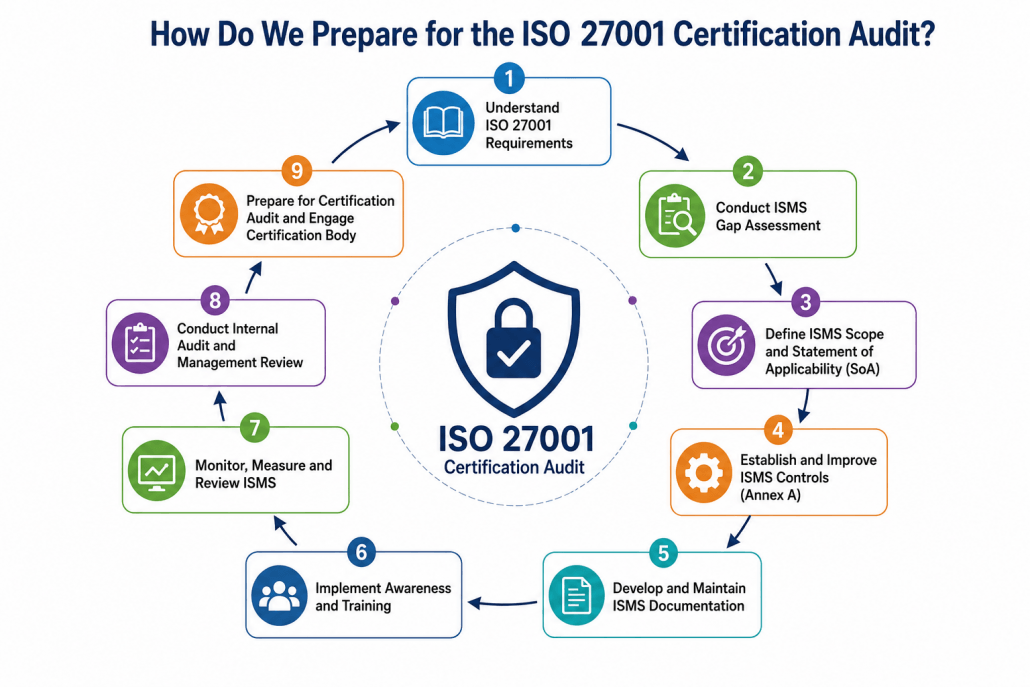
Organizations pursuing ISO/IEC 27001 certification must understand the requirements of the Information Security Management System (ISMS) standard. ISO 27001 provides a structured framework for managing information security risks, protecting sensitive data, and improving cybersecurity governance.
Here is an explanation of the ISO 27001 requirements for organizations preparing for ISO 27001 certification.
How is the standard structured and interpreted for businesses or organizations?
How to get started with ISO 27001:2022?
There are 8 key ISO 27001:2022 clauses that you need to cover to achieve conformance with ISO 27001 certification requirements.
Below is the outline for each clause for your easier understanding:
1. Context of the Organization
- Identify internal issues that affect information security, such as structure, processes, systems, and capabilities.
- Identify external issues such as legal, regulatory, technological, and market conditions.
- Determine interested parties (e.g., customers, regulators, employees, suppliers) and their information security requirements.
- Define and maintain the scope of the Information Security Management System (ISMS), including boundaries, locations, and interfaces.
- Establish, implement, maintain, and continually improve the ISMS based on the identified context.
2. Leadership
- Top management must take accountability for the effectiveness of the ISMS.
- Ensure information security policy is established and aligned with organizational direction.
- Ensure information security objectives are set and compatible with strategic goals.
- Integrate ISMS requirements into business processes.
- Ensure availability of resources for ISMS implementation.
- Communicate the importance of effective information security management.
- Assign and support roles and responsibilities for information security.
- Promote continual improvement and ensure ISMS achieves its intended results.
3. Information Security Policy
- Establish a documented information security policy appropriate to the organization.
- Include a commitment to satisfy applicable information security requirements.
- Include commitment to continual improvement of the ISMS.
- Provide a framework for setting information security objectives.
- Ensure the policy is communicated within the organization.
- Make the policy available to relevant interested parties when appropriate.
- Review the policy periodically and update when necessary.
4. Organizational Roles and Responsibilities
- Assign responsibilities and authorities relevant to information security.
- Ensure responsibilities are clearly communicated and understood.
- Assign responsibility for reporting ISMS performance to top management.
- Ensure accountability for protecting information assets is defined.
5. Planning for Risks and Opportunities
- Identify risks and opportunities that may affect ISMS performance.
- Plan actions to address risks and opportunities and integrate them into ISMS processes.
- Evaluate the effectiveness of these actions.
6. Information Security Risk Assessment
- Establish a risk assessment process with defined criteria for risk acceptance.
- Identify risks related to the confidentiality, integrity, and availability of information.
- Analyze risks by determining likelihood and impact.
- Evaluate risks to determine which require treatment.
- Ensure consistency, validity, and reproducibility of risk assessment results.
- Maintain documented information of risk assessment results.
7. Information Security Risk Treatment
- Select appropriate risk treatment options (avoid, modify, share, retain).
- Determine necessary controls to implement risk treatment.
- Compare selected controls with Annex A to ensure no omissions.
- Prepare a Statement of Applicability listing:
- Selected controls
- Justification for inclusion or exclusion
- Implementation status
- Develop and maintain a risk treatment plan.
- Obtain approval from risk owners and acceptance of residual risks.
8. Information Security Objectives
- Establish measurable information security objectives where applicable.
- Ensure objectives are consistent with the information security policy.
- Consider applicable requirements and risk assessment results when setting objectives.
- Define how objectives will be achieved, including:
- Actions required
- Responsible persons
- Resources needed
- Timeframes
- Methods for evaluation
- Monitor and update objectives as necessary.
- Maintain documented information on objectives.
9. Support and Resources
- Provide sufficient resources for ISMS establishment and maintenance.
- Ensure personnel are competent based on education, training, or experience.
- Conduct awareness programs so employees understand:
- Information security policy
- Their role in ISMS effectiveness
- Consequences of nonconformity
- Ensure internal and external communication processes are defined and implemented.
- Control documented information to ensure availability, protection, and proper handling.
- Ensure documents are properly identified, reviewed, updated, and approved.
10. Operational Control
- Plan, implement, and control processes required to meet ISMS requirements.
- Implement risk treatment plans effectively.
- Perform risk assessments at planned intervals and when significant changes occur.
- Control changes to ISMS processes to ensure integrity and consistency.
- Retain evidence that processes are carried out as planned.
11. Performance Evaluation
- Monitor, measure, analyze, and evaluate ISMS performance.
- Determine what needs to be measured and the measurement methods.
- Conduct internal audits at planned intervals to ensure ISMS conformity and effectiveness.
- Ensure independent and objective auditors conduct audits.
- Perform management reviews at planned intervals covering:
- ISMS performance
- Audit results
- Risk status
- Achievement of objectives
- Nonconformities and corrective actions
- Opportunities for improvement
- Maintain documented results of audits and management reviews.
12. Improvement
- Continually improve the suitability, adequacy, and effectiveness of the ISMS.
- Address nonconformities by:
- Containing and correcting issues
- Determining root causes
- Implementing corrective actions
- Evaluating the effectiveness of actions
- Update risks and ISMS documentation when necessary.
- Retain records of corrective actions and improvements.
Mandatory Documents Required for ISO/IEC 27001:2022 Certification
- ISMS Scope
- Information Security Policy
- Information Security Risk Assessment Process / Methodology
- Information Security Risk Assessment Results
- Information Security Risk Treatment Process
- Statement of Applicability (SoA)
- Information Security Risk Treatment Plan
- Information Security Objectives
- Evidence of Competence
- Controlled Documented Information
- Operational Records needed to show processes are carried out as planned
- Results of Risk Assessments performed during operation
- Results of Risk Treatment
- Monitoring and Measurement Results
- Internal Audit Programme and Audit Results
- Management Review Results
- Nonconformity and Corrective Action Records
https://www.pearl-certification.com/wp-content/uploads/2023/06/Pearl-Certification-logo-web-1.png
0
0
aisyah
https://www.pearl-certification.com/wp-content/uploads/2023/06/Pearl-Certification-logo-web-1.png
aisyah2026-08-21 02:50:352026-08-25 14:38:45MS 1480:2025 Food Safety Management System – What Businesses Need to Know https://www.pearl-certification.com/wp-content/uploads/2026/08/business-man-show-money-bank-note-make-financial-plan-invite-people-sell-buy-house-car-monetary-properties-loan-credit-insurance-concept-scaled.jpg
1709
2560
aisyah
https://www.pearl-certification.com/wp-content/uploads/2023/06/Pearl-Certification-logo-web-1.png
aisyah2026-08-21 02:29:222026-08-21 02:30:28ISO 41001 for Property Management
https://www.pearl-certification.com/wp-content/uploads/2026/08/business-man-show-money-bank-note-make-financial-plan-invite-people-sell-buy-house-car-monetary-properties-loan-credit-insurance-concept-scaled.jpg
1709
2560
aisyah
https://www.pearl-certification.com/wp-content/uploads/2023/06/Pearl-Certification-logo-web-1.png
aisyah2026-08-21 02:29:222026-08-21 02:30:28ISO 41001 for Property Management https://www.pearl-certification.com/wp-content/uploads/2026/08/closeup-shot-metal-handcuffs-dollars-scaled.jpg
1707
2560
aisyah
https://www.pearl-certification.com/wp-content/uploads/2023/06/Pearl-Certification-logo-web-1.png
aisyah2026-08-21 02:02:572026-08-21 02:02:57ISO 37001 and Section 17A MACC Act – Complete Guide for Malaysian Companies
https://www.pearl-certification.com/wp-content/uploads/2026/08/closeup-shot-metal-handcuffs-dollars-scaled.jpg
1707
2560
aisyah
https://www.pearl-certification.com/wp-content/uploads/2023/06/Pearl-Certification-logo-web-1.png
aisyah2026-08-21 02:02:572026-08-21 02:02:57ISO 37001 and Section 17A MACC Act – Complete Guide for Malaysian Companies https://www.pearl-certification.com/wp-content/uploads/2026/08/developer-identifying-server-issues-scaled.jpg
1440
2560
aisyah
https://www.pearl-certification.com/wp-content/uploads/2023/06/Pearl-Certification-logo-web-1.png
aisyah2026-08-18 07:07:082026-08-20 01:39:19ISO 27001 certification for data centres
https://www.pearl-certification.com/wp-content/uploads/2026/08/developer-identifying-server-issues-scaled.jpg
1440
2560
aisyah
https://www.pearl-certification.com/wp-content/uploads/2023/06/Pearl-Certification-logo-web-1.png
aisyah2026-08-18 07:07:082026-08-20 01:39:19ISO 27001 certification for data centres https://www.pearl-certification.com/wp-content/uploads/2026/08/standard-quality-control-collage-concept-scaled.jpg
1440
2560
aisyah
https://www.pearl-certification.com/wp-content/uploads/2023/06/Pearl-Certification-logo-web-1.png
aisyah2026-08-18 02:47:422026-08-20 01:40:50ISO 27001 Certification for SMEs: Secure Your Business with Confidence
https://www.pearl-certification.com/wp-content/uploads/2026/08/standard-quality-control-collage-concept-scaled.jpg
1440
2560
aisyah
https://www.pearl-certification.com/wp-content/uploads/2023/06/Pearl-Certification-logo-web-1.png
aisyah2026-08-18 02:47:422026-08-20 01:40:50ISO 27001 Certification for SMEs: Secure Your Business with Confidence https://www.pearl-certification.com/wp-content/uploads/2026/08/person-working-html-computer-scaled.jpg
1707
2560
aisyah
https://www.pearl-certification.com/wp-content/uploads/2023/06/Pearl-Certification-logo-web-1.png
aisyah2026-08-05 01:51:512026-08-20 01:42:50ISO 27001 certification for software companies
https://www.pearl-certification.com/wp-content/uploads/2026/08/person-working-html-computer-scaled.jpg
1707
2560
aisyah
https://www.pearl-certification.com/wp-content/uploads/2023/06/Pearl-Certification-logo-web-1.png
aisyah2026-08-05 01:51:512026-08-20 01:42:50ISO 27001 certification for software companies https://www.pearl-certification.com/wp-content/uploads/2026/08/corporate-businessmen-working-tablet-office-scaled.jpg
1440
2560
aisyah
https://www.pearl-certification.com/wp-content/uploads/2023/06/Pearl-Certification-logo-web-1.png
aisyah2026-08-04 08:54:452026-08-04 08:54:45ISO 9001:2026 Transition Guide – Timeline, Key Changes & How to Prepare
https://www.pearl-certification.com/wp-content/uploads/2026/08/corporate-businessmen-working-tablet-office-scaled.jpg
1440
2560
aisyah
https://www.pearl-certification.com/wp-content/uploads/2023/06/Pearl-Certification-logo-web-1.png
aisyah2026-08-04 08:54:452026-08-04 08:54:45ISO 9001:2026 Transition Guide – Timeline, Key Changes & How to Prepare https://www.pearl-certification.com/wp-content/uploads/2026/07/young-businessman-working-from-his-office-counting-cash-money-scaled.jpg
1707
2560
aisyah
https://www.pearl-certification.com/wp-content/uploads/2023/06/Pearl-Certification-logo-web-1.png
aisyah2026-07-14 01:57:592026-07-23 07:44:29ISO 37001 Requirements Explained | Complete Guide for Malaysian Businesses
https://www.pearl-certification.com/wp-content/uploads/2026/07/ESG.jpg
1080
1920
aisyah
https://www.pearl-certification.com/wp-content/uploads/2023/06/Pearl-Certification-logo-web-1.png
aisyah2026-07-06 02:07:092026-07-07 01:12:31ISO Certification and ESG in Malaysia | How ISO Standards Support ESG
https://www.pearl-certification.com/wp-content/uploads/2026/07/young-businessman-working-from-his-office-counting-cash-money-scaled.jpg
1707
2560
aisyah
https://www.pearl-certification.com/wp-content/uploads/2023/06/Pearl-Certification-logo-web-1.png
aisyah2026-07-14 01:57:592026-07-23 07:44:29ISO 37001 Requirements Explained | Complete Guide for Malaysian Businesses
https://www.pearl-certification.com/wp-content/uploads/2026/07/ESG.jpg
1080
1920
aisyah
https://www.pearl-certification.com/wp-content/uploads/2023/06/Pearl-Certification-logo-web-1.png
aisyah2026-07-06 02:07:092026-07-07 01:12:31ISO Certification and ESG in Malaysia | How ISO Standards Support ESGPearl Certification Sdn Bhd (1311494-U)
ZP-02-11, Zest Point, Lebuhraya Bukit Jalil, 47180 Puchong, Selangor, Malaysia.
Email : info@pearl-certification.com
Tel : +603-6280 6835


