
 https://www.pearl-certification.com/wp-content/uploads/2023/06/Pearl-Certification-logo-web-1.png
0
0
aisyah
https://www.pearl-certification.com/wp-content/uploads/2023/06/Pearl-Certification-logo-web-1.png
aisyah2026-08-21 02:50:352026-08-25 14:38:45MS 1480:2025 Food Safety Management System – What Businesses Need to Know
https://www.pearl-certification.com/wp-content/uploads/2023/06/Pearl-Certification-logo-web-1.png
0
0
aisyah
https://www.pearl-certification.com/wp-content/uploads/2023/06/Pearl-Certification-logo-web-1.png
aisyah2026-08-21 02:50:352026-08-25 14:38:45MS 1480:2025 Food Safety Management System – What Businesses Need to KnowISO 14001:2026 Revision: Key Changes & How Organizations Should Prepare
In today’s business world, environmental management is no longer just a compliance requirement or corporate social responsibility. It has become part of the organization’s strategy to ensure operational sustainability, better risk management, and increased trust from customers, investors, and stakeholders.
Since its introduction in 1996 and through several significant revisions, ISO 14001 continues to evolve to ensure that this standard remains relevant to the increasingly complex global environmental challenges. The latest 2026 revision was published in April 2026. Several important improvements are anticipated to be introduced to further strengthen the implementation of the Environmental Management System (EMS) within organizations.
For organizations that have been certified under ISO 14001, understanding these anticipated changes early can help in making more systematic preparations and ensuring that the environmental management system remains relevant and effective.
Here are several key changes expected in the ISO 14001:2026 revision, including the clauses involved and the implications for certified organizations, including auditors who will conduct environmental management system assessments.
Expectations of Major Changes in ISO14001:2026
1. Clearer Explanation Regarding the Environment Clearer Explanation Regarding the Environmental Conditions
Involved clause: Clause 4 – Context of the Organization
In this revision, Clause 4 is expected to place clearer emphasis on the environmental conditions as part of the organizational context. Organizations not only need to identify internal and external issues that affect the EMS, but also consider environmental conditions relevant to their operations. This includes factors such as climate change, air quality, natural resource consumption, and other environmental issues that can affect the organization.
Additionally, the scope of the EMS is also expected to take into account the life cycle perspective more clearly to ensure that the environmental impact is assessed more comprehensively.
2. Addition of a New Clause Related to Change Management
Involved clause: Clause 6 – Planning (addition of Clause 6.3)
Another expected change is the addition of Clause 6.3 related to change management in ISO14001. The addition of this clause aims to ensure that organizations can manage changes occurring in operations, processes, or activities that may impact the environment.
In addition, the planning structure in Clause 6 is also expected to be detailed with additional subdivisions to sub-clauses such as Clause 6.1.4 and Clause 6.1.5, to provide clearer explanations regarding actions in addressing risks and opportunities.
This approach helps organizations ensure that every change is assessed from an environmental impact perspective before implementation.
3. Development of Operational Control for Business Partners and Suppliers: Expansion of Operational Control to Business Partners and Suppliers
Involved clause: Clause 8 – Operation
In the new version of ISO14001:2026, Clause 8 is expected to be updated in terms of terminology and the scope of operational control.
This change is expected to expand the operational control requirements so that they are not only focused on the internal activities of the organization but also involve external parties such as suppliers, contractors, and business partners.
This approach aligns with the concept of lifecycle thinking, which emphasizes that environmental impacts can occur throughout the organization’s value chain. Therefore, organizations may need to demonstrate how environmental controls are also implemented in supplier and partner management.
4. A Clearer Assessment of Environmental Performance Clearer Assessment of Environmental Performance
Involved clause: Clause 9 – Performance Evaluation
In this new 2026 revision, Clause 9 is expected to place a clearer emphasis on the need to evaluate environmental performance and the effectiveness of the EMS.
Organizations may need to demonstrate a more systematic evaluation of:
• achievement of environmental objectives
• overall EMS performance
• effectiveness of system implementation
In addition, the audit objectives are also expected to be defined more clearly to ensure that the internal audit truly assesses the effectiveness of the environmental management system.
5. Restructuring the Improvement Clause
Involved clause: Clause 10 – Improvement
Another expected change in ISO14001 is the restructuring of Clause 10.
Clause 10.1 is expected to be merged into Clause 10.2 and Clause 10.3 to make the improvement structure simpler and more aligned with the continuous improvement approach.
Additionally, findings from audits, monitoring, and performance evaluations are expected to be more clearly linked to the continual improvement process in the EMS.
This approach helps ensure that each finding or non-compliance is not only corrected but also used as input to improve the overall performance of the system.
| No. | Involved Clause | Key Changes | Impact on Organizations |
| 1 | Clause 4 – Context of the Organization |
Clearer emphasis on environmental conditions | Organizations must consider factors like climate change, air quality, and resource usage while defining EMS scope with a stronger life cycle perspective. |
| 2 | Clause 6 – Planning (addition of Clause 6.3) |
Introduction of the change management clause | Organizations need to assess environmental impacts before implementing operational or process changes; planning becomes more structured for risks and opportunities. |
| 3 | Clause 8 – Operation | Expansion of operational control to external parties | Environmental controls must extend beyond internal processes to suppliers, contractors, and business partners across the value chain. |
| 4 | Clause 9 – Performance Evaluation | More systematic environmental performance evaluation | Organizations must clearly demonstrate achievement of objectives, EMS effectiveness, and conduct more focused internal audits. |
| 5 | Clause 10 – Improvement | Restructuring of the improvement clause | Simplified structure with stronger linkage between audit findings and continual improvement to enhance overall EMS performance. |
How this ISO 14001:2026 can impact the Organization?
For organizations that have been certified under ISO14001, the expected changes are actually not too drastic. Most of the changes are more about clarification and reinforcement of the concepts that were introduced in the previous edition.
Organizations that have effectively implemented EMS are likely to already have many of the necessary elements.
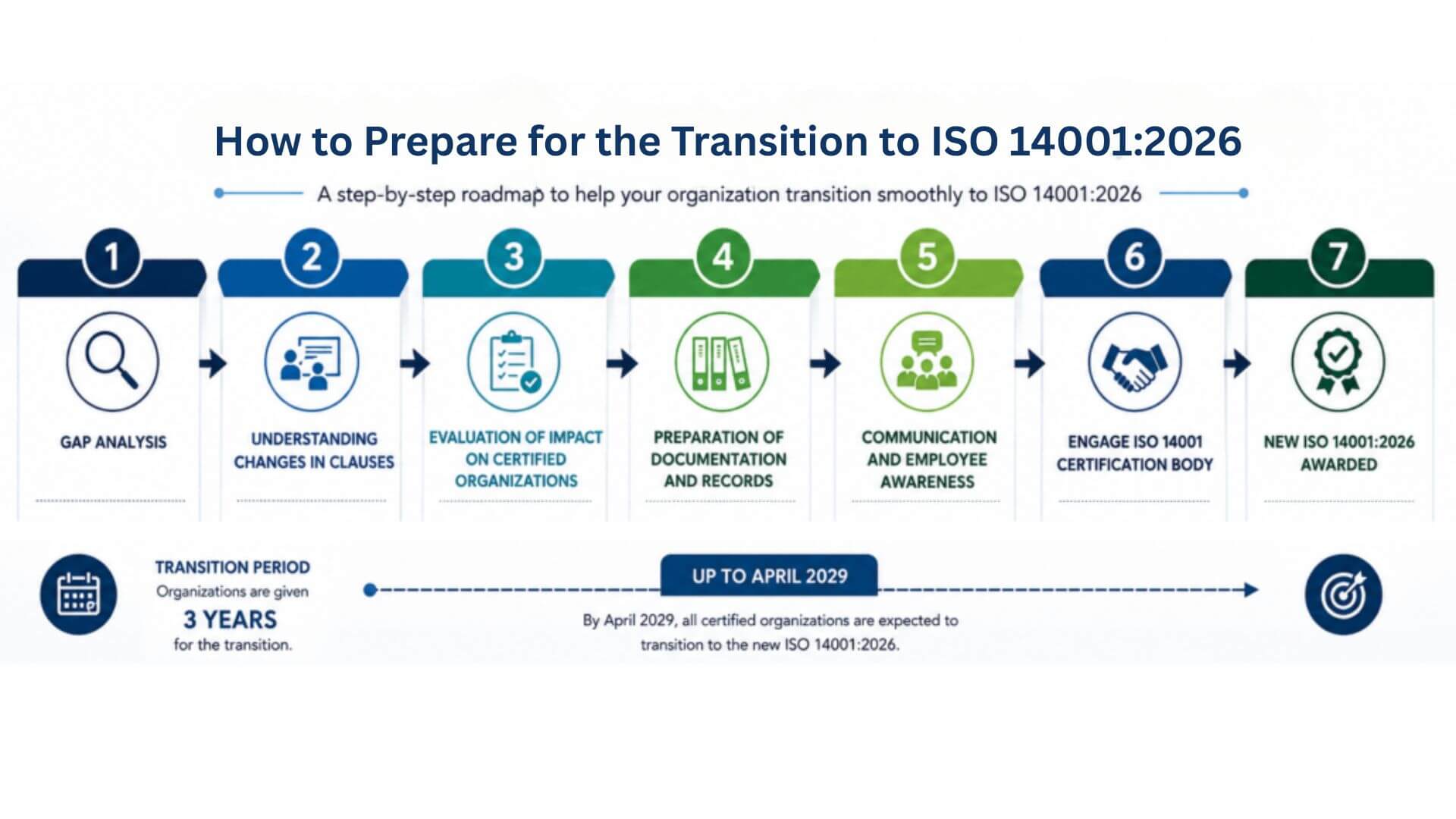
Preparation step of transition to ISO 14001:2026
The organization is given 3 years for the transition. By April 2029, all certified organization expected to transition to the new ISO 14001:2026.
To ensure the organization is ready to face the new version of ISO 14001:2026, several initial steps can be taken:
1. Gap Analysis
Review the differences between the existing system and the requirements of version 2026, including changes in the organizational context, stakeholders, and environmental aspects.
2. Understanding Changes to Clauses
Train internal auditors and management teams on clause changes, particularly emphasizing the risk and opportunity approach, as well as the integration of environmental aspects into the organization’s strategy.
3. Impact Assessment on Certified Organizations
Identify the processes involved, the resources required, and any implications for compliance and existing records.
4. Preparation of Documentation and Records
Ensure all procedures, manuals, and records are updated according to new requirements and easily accessible for audits.
5. Communication and Employee Awareness
Involve all levels of the organization through awareness sessions to ensure understanding of the changes in standards and their roles in compliance.
6. Engage the ISO 14001 Certification Body for the transition audit.
7. New ISO 14001:2026 awarded
Conclusion
The review of international standards is an important process to ensure that these standards remain relevant to global developments. Similarly, ISO14001 is constantly updated to help organizations manage their environmental responsibilities more effectively.
With an emphasis on environmental context, change management, broader operational control, clearer performance evaluation, and continual improvement, the new version of ISO14001:2026 is expected to help organizations further strengthen the implementation of their environmental management systems.
Ultimately, the implementation of ISO14001 is not merely for certification purposes, but rather a strategic approach to ensure that organizations operate in a more sustainable and environmentally responsible manner.
https://www.pearl-certification.com/wp-content/uploads/2023/06/Pearl-Certification-logo-web-1.png
0
0
aisyah
https://www.pearl-certification.com/wp-content/uploads/2023/06/Pearl-Certification-logo-web-1.png
aisyah2026-08-21 02:50:352026-08-25 14:38:45MS 1480:2025 Food Safety Management System – What Businesses Need to Know https://www.pearl-certification.com/wp-content/uploads/2026/08/business-man-show-money-bank-note-make-financial-plan-invite-people-sell-buy-house-car-monetary-properties-loan-credit-insurance-concept-scaled.jpg
1709
2560
aisyah
https://www.pearl-certification.com/wp-content/uploads/2023/06/Pearl-Certification-logo-web-1.png
aisyah2026-08-21 02:29:222026-08-21 02:30:28ISO 41001 for Property Management
https://www.pearl-certification.com/wp-content/uploads/2026/08/business-man-show-money-bank-note-make-financial-plan-invite-people-sell-buy-house-car-monetary-properties-loan-credit-insurance-concept-scaled.jpg
1709
2560
aisyah
https://www.pearl-certification.com/wp-content/uploads/2023/06/Pearl-Certification-logo-web-1.png
aisyah2026-08-21 02:29:222026-08-21 02:30:28ISO 41001 for Property Management https://www.pearl-certification.com/wp-content/uploads/2026/08/closeup-shot-metal-handcuffs-dollars-scaled.jpg
1707
2560
aisyah
https://www.pearl-certification.com/wp-content/uploads/2023/06/Pearl-Certification-logo-web-1.png
aisyah2026-08-21 02:02:572026-08-21 02:02:57ISO 37001 and Section 17A MACC Act – Complete Guide for Malaysian Companies
https://www.pearl-certification.com/wp-content/uploads/2026/08/closeup-shot-metal-handcuffs-dollars-scaled.jpg
1707
2560
aisyah
https://www.pearl-certification.com/wp-content/uploads/2023/06/Pearl-Certification-logo-web-1.png
aisyah2026-08-21 02:02:572026-08-21 02:02:57ISO 37001 and Section 17A MACC Act – Complete Guide for Malaysian Companies https://www.pearl-certification.com/wp-content/uploads/2026/08/developer-identifying-server-issues-scaled.jpg
1440
2560
aisyah
https://www.pearl-certification.com/wp-content/uploads/2023/06/Pearl-Certification-logo-web-1.png
aisyah2026-08-18 07:07:082026-08-20 01:39:19ISO 27001 certification for data centres
https://www.pearl-certification.com/wp-content/uploads/2026/08/developer-identifying-server-issues-scaled.jpg
1440
2560
aisyah
https://www.pearl-certification.com/wp-content/uploads/2023/06/Pearl-Certification-logo-web-1.png
aisyah2026-08-18 07:07:082026-08-20 01:39:19ISO 27001 certification for data centres https://www.pearl-certification.com/wp-content/uploads/2026/08/standard-quality-control-collage-concept-scaled.jpg
1440
2560
aisyah
https://www.pearl-certification.com/wp-content/uploads/2023/06/Pearl-Certification-logo-web-1.png
aisyah2026-08-18 02:47:422026-08-20 01:40:50ISO 27001 Certification for SMEs: Secure Your Business with Confidence
https://www.pearl-certification.com/wp-content/uploads/2026/08/standard-quality-control-collage-concept-scaled.jpg
1440
2560
aisyah
https://www.pearl-certification.com/wp-content/uploads/2023/06/Pearl-Certification-logo-web-1.png
aisyah2026-08-18 02:47:422026-08-20 01:40:50ISO 27001 Certification for SMEs: Secure Your Business with Confidence https://www.pearl-certification.com/wp-content/uploads/2026/08/person-working-html-computer-scaled.jpg
1707
2560
aisyah
https://www.pearl-certification.com/wp-content/uploads/2023/06/Pearl-Certification-logo-web-1.png
aisyah2026-08-05 01:51:512026-08-20 01:42:50ISO 27001 certification for software companies
https://www.pearl-certification.com/wp-content/uploads/2026/08/person-working-html-computer-scaled.jpg
1707
2560
aisyah
https://www.pearl-certification.com/wp-content/uploads/2023/06/Pearl-Certification-logo-web-1.png
aisyah2026-08-05 01:51:512026-08-20 01:42:50ISO 27001 certification for software companies https://www.pearl-certification.com/wp-content/uploads/2026/08/corporate-businessmen-working-tablet-office-scaled.jpg
1440
2560
aisyah
https://www.pearl-certification.com/wp-content/uploads/2023/06/Pearl-Certification-logo-web-1.png
aisyah2026-08-04 08:54:452026-08-04 08:54:45ISO 9001:2026 Transition Guide – Timeline, Key Changes & How to Prepare
https://www.pearl-certification.com/wp-content/uploads/2026/08/corporate-businessmen-working-tablet-office-scaled.jpg
1440
2560
aisyah
https://www.pearl-certification.com/wp-content/uploads/2023/06/Pearl-Certification-logo-web-1.png
aisyah2026-08-04 08:54:452026-08-04 08:54:45ISO 9001:2026 Transition Guide – Timeline, Key Changes & How to Prepare https://www.pearl-certification.com/wp-content/uploads/2026/07/young-businessman-working-from-his-office-counting-cash-money-scaled.jpg
1707
2560
aisyah
https://www.pearl-certification.com/wp-content/uploads/2023/06/Pearl-Certification-logo-web-1.png
aisyah2026-07-14 01:57:592026-07-23 07:44:29ISO 37001 Requirements Explained | Complete Guide for Malaysian Businesses
https://www.pearl-certification.com/wp-content/uploads/2026/07/ESG.jpg
1080
1920
aisyah
https://www.pearl-certification.com/wp-content/uploads/2023/06/Pearl-Certification-logo-web-1.png
aisyah2026-07-06 02:07:092026-07-07 01:12:31ISO Certification and ESG in Malaysia | How ISO Standards Support ESG
https://www.pearl-certification.com/wp-content/uploads/2026/07/young-businessman-working-from-his-office-counting-cash-money-scaled.jpg
1707
2560
aisyah
https://www.pearl-certification.com/wp-content/uploads/2023/06/Pearl-Certification-logo-web-1.png
aisyah2026-07-14 01:57:592026-07-23 07:44:29ISO 37001 Requirements Explained | Complete Guide for Malaysian Businesses
https://www.pearl-certification.com/wp-content/uploads/2026/07/ESG.jpg
1080
1920
aisyah
https://www.pearl-certification.com/wp-content/uploads/2023/06/Pearl-Certification-logo-web-1.png
aisyah2026-07-06 02:07:092026-07-07 01:12:31ISO Certification and ESG in Malaysia | How ISO Standards Support ESGPearl Certification Sdn Bhd (1311494-U)
ZP-02-11, Zest Point, Lebuhraya Bukit Jalil, 47180 Puchong, Selangor, Malaysia.
Email : info@pearl-certification.com
Tel : +603-6280 6835


