
 https://www.pearl-certification.com/wp-content/uploads/2026/08/developer-identifying-server-issues-scaled.jpg
1440
2560
aisyah
https://www.pearl-certification.com/wp-content/uploads/2023/06/Pearl-Certification-logo-web-1.png
aisyah2026-08-18 07:07:082026-08-20 01:39:19ISO 27001 certification for data centres
https://www.pearl-certification.com/wp-content/uploads/2026/08/developer-identifying-server-issues-scaled.jpg
1440
2560
aisyah
https://www.pearl-certification.com/wp-content/uploads/2023/06/Pearl-Certification-logo-web-1.png
aisyah2026-08-18 07:07:082026-08-20 01:39:19ISO 27001 certification for data centresISO 27001 Certification for SMEs: Requirements, Benefits and How to Prepare
ISO 27001 certification for SMEs is an independent assessment that verifies whether a small or medium-sized organization has established and operates an Information Security Management System (ISMS) that meets the requirements of ISO/IEC 27001. The standard is applicable to organizations of any size and can be scaled according to the organization’s information security risks, business activities and needs.
Instead of seeing ISO 27001 as a requirement only for large corporations, more SMEs are using it as a practical framework to strengthen operations, improve customer confidence, and support long-term growth.
Why Should SMEs Consider ISO 27001?
SMEs often face unique challenges when managing information security. Limited resources, growing digital operations, and increasing cybersecurity risks make it essential to have structured security processes in place.
ISO 27001 certification is particularly beneficial for SMEs that:
- Want to qualify for government or corporate tenders
- Work with clients that require security compliance
- Store customer or confidential business information
- Operate cloud-based systems or digital platforms
- Need to meet contractual or regulatory requirements
- Plan to expand into international markets
For some SMEs, ISO 27001 certification may be requested by customers, business partners, tender requirements, or contractual arrangements. For others, implementing an ISMS may be sufficient without pursuing third-party certification.
As businesses increasingly rely on digital systems and online services, clients expect suppliers to demonstrate strong information security practices. ISO 27001 certification enables SMEs to compete for larger projects, build stronger business relationships, and meet evolving customer expectations.
Whether you’re a growing startup or an established SME, investing in information security today helps position your business for sustainable growth tomorrow.
Does an SME need ISO 27001 certification?
Not every SME needs ISO 27001 certification. However, it can be particularly valuable for organizations that handle sensitive information, provide technology services, work with enterprise customers, participate in tenders, or need to demonstrate a structured approach to information security. The decision should be based on the organization’s risks, customer expectations, and business objectives.
How do I know if the company is ready for ISO 27001?
Are you ready for these:
- The ISMS scope has been defined
- Information assets have been identified
- Information security risks have been assessed
- Risk treatment decisions have been documented
- Relevant policies and procedures are established
- Employees understand their information security responsibilities
- Applicable controls have been implemented
- Internal audit has been conducted
- Management review has been completed
- Corrective actions have been addressed
Common Challenges SMEs Face
While many SMEs recognize the importance of certification, implementation can be challenging without proper planning.
Some common obstacles include:
- Limited manpower and internal expertise
- Lack of documented policies and procedures
- Difficulty identifying information security risks
- Preparing documentation for certification audits
- Maintaining compliance after certification
Working with an experienced partner can help SMEs implement the required controls more efficiently while minimizing disruption to daily operations.
Preparing Your SME for Certification
Before starting the certification process, SMEs should ensure they have:
- Clear information security policies
- Defined business processes
- Risk assessment and treatment plans
- Employee awareness and training
- Documented procedures and records
- Internal audit and management review processes
Being prepared from the beginning can reduce implementation time and improve audit readiness.
Information security today helps position your business for sustainable growth tomorrow.
What Does an ISO 27001 Auditor Check in an SME?
An auditor may examine evidence relating to areas such as:
- ISMS scope
- Risk assessment
- Risk treatment
- Information security objectives
- Policies
- Competence and awareness
- Access control
- Asset management
- Incident management
- Supplier security
- Backup and recovery
- Internal audit
- Management review
- Corrective action
How Can an SME Obtain ISO 27001 Certification?
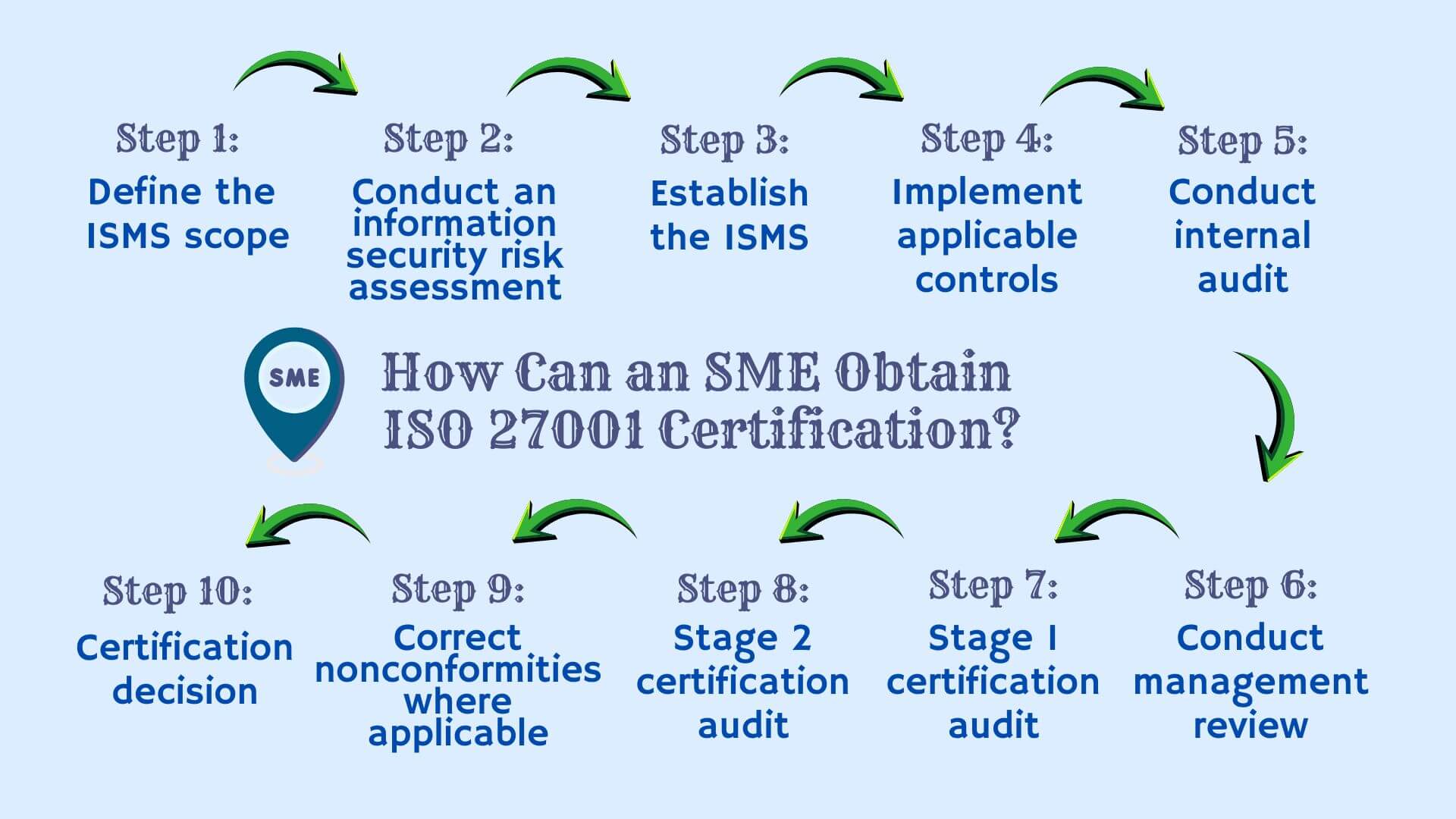
Looking for ISO 27001 Certification for Your SME?
An implementation consultant may assist an SME in developing and implementing its ISMS. The ISO 27001 certification body, however, performs an independent conformity assessment and determines whether the organization’s management system meets the applicable certification requirements. Choose an experienced accredited certification body to ensure a smooth, internationally recognized certification process.
Contact us today to get your SME ISO 27001 certified with confidence.
Does an SME need ISO 27001 certification?
ISO 27001 certification is not mandatory for every SME. However, it can be highly beneficial for businesses that handle sensitive customer data, financial information, or confidential business information. It also helps demonstrate strong information security practices and can build trust with customers and business partners.
How long does ISO 27001 certification take for an SME?
The certification process typically takes 3 to 6 months, depending on the size and complexity of the business, the scope of certification, and how prepared the organisation is. SMEs with well-established information security practices may complete the process faster.
How much does ISO 27001 certification cost for an SME?
The cost varies depending on factors such as the organisation’s size, number of employees, certification scope, existing security controls, and whether consultancy support is required. SMEs should obtain a quotation based on their specific requirements, as there is no fixed certification cost.
Can a small business get ISO 27001 certified?
Yes. ISO 27001 certification is suitable for businesses of all sizes, including small businesses. A small business can define a certification scope that fits its operations and implement an information security management system (ISMS) appropriate to its size and needs.
https://www.pearl-certification.com/wp-content/uploads/2026/08/developer-identifying-server-issues-scaled.jpg
1440
2560
aisyah
https://www.pearl-certification.com/wp-content/uploads/2023/06/Pearl-Certification-logo-web-1.png
aisyah2026-08-18 07:07:082026-08-20 01:39:19ISO 27001 certification for data centres https://www.pearl-certification.com/wp-content/uploads/2026/08/standard-quality-control-collage-concept-scaled.jpg
1440
2560
aisyah
https://www.pearl-certification.com/wp-content/uploads/2023/06/Pearl-Certification-logo-web-1.png
aisyah2026-08-18 02:47:422026-08-20 01:40:50ISO 27001 Certification for SMEs: Secure Your Business with Confidence
https://www.pearl-certification.com/wp-content/uploads/2026/08/standard-quality-control-collage-concept-scaled.jpg
1440
2560
aisyah
https://www.pearl-certification.com/wp-content/uploads/2023/06/Pearl-Certification-logo-web-1.png
aisyah2026-08-18 02:47:422026-08-20 01:40:50ISO 27001 Certification for SMEs: Secure Your Business with Confidence https://www.pearl-certification.com/wp-content/uploads/2026/08/person-working-html-computer-scaled.jpg
1707
2560
aisyah
https://www.pearl-certification.com/wp-content/uploads/2023/06/Pearl-Certification-logo-web-1.png
aisyah2026-08-05 01:51:512026-08-20 01:42:50ISO 27001 certification for software companies
https://www.pearl-certification.com/wp-content/uploads/2026/08/person-working-html-computer-scaled.jpg
1707
2560
aisyah
https://www.pearl-certification.com/wp-content/uploads/2023/06/Pearl-Certification-logo-web-1.png
aisyah2026-08-05 01:51:512026-08-20 01:42:50ISO 27001 certification for software companiesPearl Certification Sdn Bhd (1311494-U)
ZP-02-11, Zest Point, Lebuhraya Bukit Jalil, 47180 Puchong, Selangor, Malaysia.
Email : info@pearl-certification.com
Tel : +603-6280 6835


